
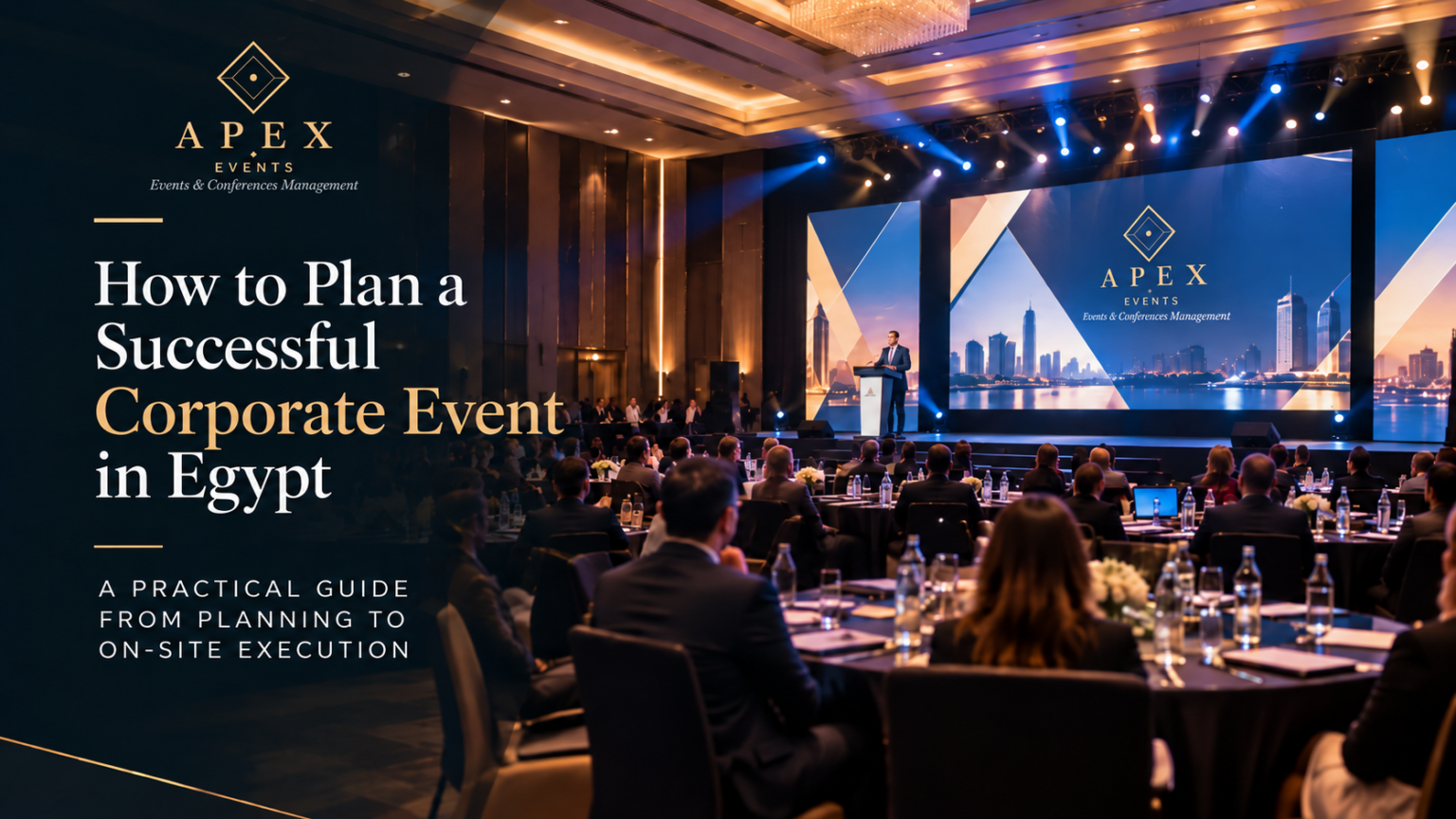
Planning a successful corporate event in Egypt takes more than booking a venue and setting a date. First, define a clear business objective. Then connect planning, production, guest experience and on-site execution within one coordinated plan.
1. Start with a clear event objective
Before choosing a venue or developing a visual concept, define what the event needs to achieve. A leadership meeting, product launch, annual conference, partner gathering and internal celebration all require different formats, production priorities and guest journeys.
Useful questions include: Who is the audience? What should guests understand or do after the event? What level of formality is appropriate? What is the key message? Which stakeholders need to approve the event?
2. Build the scope around the audience
Guest numbers affect almost every planning decision. They influence venue size, registration flow, seating, catering, stage visibility, audio coverage and staffing. Therefore, set a realistic attendance estimate early and update it as confirmations progress.
For senior corporate audiences, the experience should feel smooth and intentional from arrival to departure. Signage, reception, registration, seating and transitions between sessions should be planned as part of one journey.
3. Select the venue based on operational needs
A venue should support the event format, not force the event to work around major limitations. Before confirming the space, check ceiling height, stage dimensions, access doors, loading routes, power, rigging restrictions, internet, parking, guest circulation and emergency access.
For conference-style events, sightlines and acoustics are especially important. For larger branded events, production access and setup time can be just as important as the appearance of the ballroom or hall.
4. Plan technical production early
Technical production should not be treated as a last-minute layer. Instead, coordinate stage design, LED screens, sound, lighting, presentation content, branding and control systems from the beginning.
Early technical planning reduces conflicts between design and venue limitations and helps the production team prepare the correct equipment, cabling, power distribution and operating positions.
5. Create a detailed event timeline
A working timeline should cover more than the event start and end times. It should also include supplier access, setup, rehearsals, speaker checks, registration, session timings, breaks, content playback, catering, dismantling and final handover.
For complex events, a minute-by-minute run of show helps align the client team, event manager, production crew, speakers and venue operations.
6. Prepare speakers, presentations and content
Presentations should be collected and checked before event day whenever possible. This allows the technical team to confirm aspect ratios, fonts, video playback, transitions and speaker order.
A dedicated presentation operator or show caller can help keep content synchronized with the stage programme and reduce delays during live sessions.
7. Coordinate suppliers through one event plan
Events often involve several suppliers for production, branding, furniture, catering, registration, entertainment and logistics. However, choosing them is only one part of the job. Their work also needs to connect smoothly.
A central event management plan should define responsibilities, access times, approval points and dependencies between suppliers.
8. Rehearse the important moments
Rehearsals are particularly important for executive speeches, award sequences, panel discussions, product reveals and video-led presentations. Even a short technical rehearsal can identify microphone, lighting, playback and stage movement issues before guests arrive.
9. Manage the event on site
On event day, the event management team should coordinate venue operations, suppliers, speakers, technical production and guest-facing teams. Clear communication and defined decision-making are essential when timings shift or unexpected issues appear.
This is where a coordinated corporate event management approach adds value: planning decisions are carried through into real-time execution.
10. Review the event after delivery
After the event, review what worked, what changed and what should be improved for future editions. Useful inputs may include guest feedback, attendance figures, stakeholder comments, supplier performance and operational notes.
Corporate event planning with Apex Events
Apex Events supports corporate events and conferences in Egypt through planning, technical production, supplier coordination and professional on-site execution. Our role is to help clients move from brief to event day through one coordinated process.
For events that require broader planning and production support, explore our Complete Event Management and Event Production services.
Frequently asked questions
How early should a corporate event be planned?
Timing depends on the scale and complexity of the event, but earlier planning generally gives more flexibility for venue availability, supplier coordination, technical design and approvals.
What should be included in a corporate event brief?
A useful brief includes the objective, audience, estimated attendance, preferred date, venue requirements, programme format, branding needs, production requirements and budget parameters.
Does Apex Events handle technical production?
Yes. Apex Events can coordinate staging, LED screens, audio, lighting, presentation systems and technical operations as part of the event scope.
